Another quality eBook from Chapel Library.
“Then he said unto them, O fools and slow of heart to believe all that the prophets have spoken.”
—Luke 24:25
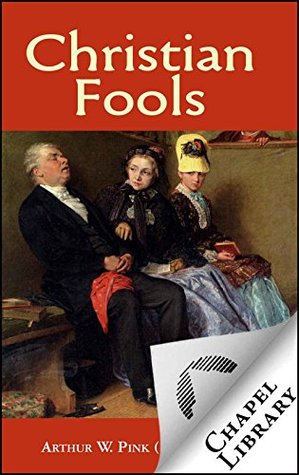
Those of you who read the religious announcements in the newspapers of yesterday would see the subject for my sermon this evening is “Christian Fools.” Possibly some of you thought there was a printer’s error and that what I really meant to announce was “Professing Christian fools.” The paper gave it quite correctly. My subject tonight is “Christian Fools.” Probably some of you think that this is a most unsuitable title for a servant of God to give to his sermon, and yet I make no apology whatever for it. It fits exactly my subject for tonight: it expresses accurately what I am going to speak about: and—what is far more to the point—it epitomizes our text: “Then he said unto them, O fools, and slow of heart to believe all that the prophets have spoken.”
Those words were spoken by Christ on the day of His resurrection: spoken not to worldlings but to Christians. That which occasioned them was this. The disciples to whom He was speaking were lopsided in their theology: they believed a certain part of God’s truth and they refused to believe another part of the truth that did not suit them; they believed some Scriptures but they did not believe all that the prophets had spoken…






















A.W. Pink (1886 - 1952)
Studied at Moodly Bible Institute and pastored some churches in America. He was not very accepted in his congregations which finally made him move back to England to be involved in writing ministry full-time till his death.He was strictly calvinist in this thinking but many of his writings also reflect balance and openness to other views of doctrine. Especially his teachings on antichrist and end-times were promoted well during his life. He wrote over 40 books and many pamphlets including he distributed titled: "Studies in the Scriptures."
Arthur Walkington Pink was a Christian evangelist and Biblical scholar known for his staunchly Calvinist and Puritan-like teachings.
Pink was born in Nottingham, England on April 1, 1886 and became a Christian in 1908, at the age of 22. Though born to Christian parents, prior to conversion he migrated into a Theosophical society (an occult gnostic group popular in England during that time), and quickly rose in prominence within their ranks. His conversion came from his father's patient admonitions from Scripture. It was the verse, Proverbs 14:12, 'there is a way which seemeth right unto a man, but the end thereof are the ways of death,' which particularly struck his heart and compelled him to renounce Theosophy and follow Jesus.
Desiring to grow in knowledge of the Bible, Pink immigrated to the United States to study at Moody Bible Institute. In 1916 he married Vera E. Russell (January 8, 1893 - July 17, 1962), who was from Kentucky. However, he left after just two months for Colorado, then California, then Britain. From 1925 to 1928 he served in Australia, including as pastor of two congregations from 1926 to 1928, when he returned to England, and to the United States the following year. He eventually pastored churches in Colorado, California, Kentucky, and South Carolina.
Converted in 1908 at the age of 22, Arthur Pink left England in 1910 to Study and Moody Bible Institue in Chicago, Illinois. He left after two months and pastored a church in Silverton, Colorado. He had short term pastorates in California, Kentuck and South Carolina.
His first major work, Divine Inspiration Of The Bible, was published in 1917, followed by The Sovereignty Of God, in 1918 which sold less than 2000 copies. He edited the magazine, Studies In The Scriptures, from 1922-1923, in which much of his published works appeared, but circulation was poor, never more than 1000 subscribers.
He spent three years preaching in Australia and returned to England in 1928 for a year. Returning to the United States he spent eight years in itinerant ministry. He returned to England for the last years of his life, living an isolated life.
Pink is famous for his writings, which had the most effect after his death, but his personal ministry as a pastor was largely a failure.
... Show more