Charles Grandison Finney (1792 - 1875) was one of the principle leaders of Second Great Awakening in the United States. He was a Congregationalist/Presbyterian pastor and is called the 'Father of Modern Revivalism'. He believed in Christian perfectionism and was an opponent of the original form of Presbyterian theology.
His religious views led him to take up a number of social causes which included equal education rights regardless of gender or race, and the end to slavery. He was appointed as a teacher at Oberlin College in Ohio, and eventually became its president, a position he held form 1851 to 1866. He remained a prolific writer and speaker until his death in 1875.
In this collection over 400 of his articles and sermons have been gathered together.

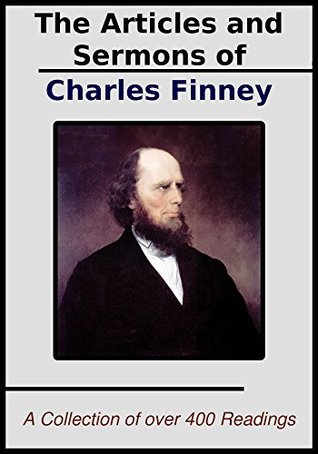





















Charles Finney (1792 - 1875)
Known as one of the leaders in the Second Great Awakening revival in America. He was a revivalist who called for deep introspection of sin and preaching of the law to bring about sin. He was known to preach 30+ nights on sin and than the last night on Christ to have people flee to Him for mercy. Used greatly in the book: "Revivals of Religion" which is a classic on the subject of revival.He preached on the true Baptism of the Holy Spirit and its necessity. In his revivalistic campaigns he was used of the Lord to bring some estimate over 50,000 souls to the Lord which many were sound converts. There has been questions raised surrounding his theology in the later years of his ministry but this does not discredit that God used him powerfully in revival and for God's kingdom.
Charles Finney was born in Connecticut to an ordinary family and life that gave little hint of the great things God had in store for him. He was a schoolteacher and then a lawyer before his conversion at age 29. Finney was filled with the Holy Spirit on the same day he was saved and immediately began witnessing to friends and family members. More than twenty people were saved in the 24 hours following Finney's conversion. Finney's personal evangelism soon became public evangelism as he began to travel and preach in extended revival meetings. He considered revival to be a natural result of following the instructions God had laid out in His Word.
During Finney's fifty years of preaching, more than 500,000 were saved. He wrote many books, the most enduring of which are The Autobiography of Charles Finney and Lectures on Revival of Religion. After ill health forced him to stop traveling in meetings, he accepted the pastorate of a church in New York City. From 1852 until 1866 he served as president of Oberlin College in Ohio. Although some of his theology was lacking, he was a powerful, Spirit-filled soul winner who brought revival to cities and towns across the eastern United States.
... Show more