
- Bible
- Read the Bible
- Bible Versions
- Verse of the Day
- Reading Plans
- Verses by Topic
- Books of the Bible
- Bible Images
- Study
- Commentaries
- Concordances
- Dictionaries
- Encyclopedias
- Sermons
- Bible Atlas & Maps
- BP Wiki
- Devotionals
- Today's Devotionals
- Light of the World
- All Devotionals
- Inspirational Quotes
- More
- Picture Quotes
- Videos
- Inspirational
- Bible Study
- What The Bible Says
- Bible Q&As
- Daily Bread
- Bible by Genre
- Bible Stories
- Random Bible Verse
- Community
- Store
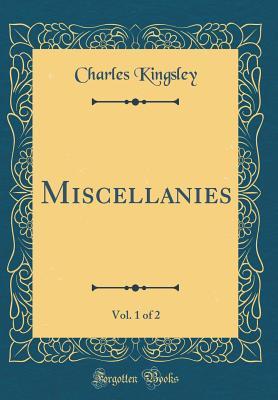
Miscellanies, Vol. 1 of 2 (Classic Reprint)
by Charles Kingsley
Excerpt from Miscellanies, Vol. 1 of 2
There are, of course, higher and lower degrees of this faith; its object is one more or less worthy: but it is in all cases the belief in certain unseen eternal facts, by keeping true to which a man must in the long run succeed. Must; because he is more or less in harmony with heaven, and earth, and the Maker thereof, and has therefore fighting on his side a great portion of the universe perhaps the Whole for as he who breaks one commandment of the law is guilty of the whole, because he denies the fount of all law, so he who with his whole Soul keeps one commandment of it is likely to be in harmony with the whole, because he testifies of the fount of all law.
I shall devote a few pages to the story of an old hero, of a man of like passions with ourselves of one who had the most intense and awful sense of the un seen laws, and succeeded mightily thereby of one who had hard struggles with a flesh and blood which made him at times forget those laws, and failed mightily thereby: of one Whom God so loved that He caused each slightest sin, as with David, to bring its own punishment with it, that While the flesh was delivered over to Satan, the man himself might be saved in the Day of the Lord; of one, finally, of whom nine hun dred and ninety-nine men out of a thousand may say, I have done worse deeds than he: but I have never done as good ones.'
About the Publisher
Forgotten Books publishes hundreds of thousands of rare and classic books. Find more at www.forgottenbooks.comwww.forgottenbooks.com
This book is a reproduction of an important historical work. Forgotten Books uses state-of-the-art technology to digitally reconstruct the work, preserving the original format whilst repairing imperfections present in the aged copy. In rare cases, an imperfection in the original, such as a blemish or missing page, may be replicated in our edition. We do, however, repair the vast majority of imperfections successfully; any imperfections that remain are intentionally left to preserve the state of such historical works.
There are, of course, higher and lower degrees of this faith; its object is one more or less worthy: but it is in all cases the belief in certain unseen eternal facts, by keeping true to which a man must in the long run succeed. Must; because he is more or less in harmony with heaven, and earth, and the Maker thereof, and has therefore fighting on his side a great portion of the universe perhaps the Whole for as he who breaks one commandment of the law is guilty of the whole, because he denies the fount of all law, so he who with his whole Soul keeps one commandment of it is likely to be in harmony with the whole, because he testifies of the fount of all law.
I shall devote a few pages to the story of an old hero, of a man of like passions with ourselves of one who had the most intense and awful sense of the un seen laws, and succeeded mightily thereby of one who had hard struggles with a flesh and blood which made him at times forget those laws, and failed mightily thereby: of one Whom God so loved that He caused each slightest sin, as with David, to bring its own punishment with it, that While the flesh was delivered over to Satan, the man himself might be saved in the Day of the Lord; of one, finally, of whom nine hun dred and ninety-nine men out of a thousand may say, I have done worse deeds than he: but I have never done as good ones.'
About the Publisher
Forgotten Books publishes hundreds of thousands of rare and classic books. Find more at www.forgottenbooks.comwww.forgottenbooks.com
This book is a reproduction of an important historical work. Forgotten Books uses state-of-the-art technology to digitally reconstruct the work, preserving the original format whilst repairing imperfections present in the aged copy. In rare cases, an imperfection in the original, such as a blemish or missing page, may be replicated in our edition. We do, however, repair the vast majority of imperfections successfully; any imperfections that remain are intentionally left to preserve the state of such historical works.
BUY NOW
Hardcover, 424 pages
Published November 28th 2018 by Forgotten Books (first published July 14th 2015)
Subscribe
Get Bible verse every day in your inbox
Read on Mobile



Group of Brands


















© 2025 Bibleportal.com All rights reserved.
As a young man, Kingsley was influenced by The Kingdom of Christ (1838) by Frederick Denison Maurice. Originally intended for the legal profession, he changed his mind and chose to pursue a ministry in the church.
In 1850 Kingsley novel Alton Locke was published. The book attempted to expose the social injustice suffered by agricultural labourers and workers in the clothing trade. In Alton Locke Kingsley also describes the Chartist campaign that he was involved with in the 1840s.
Kingsley's life was written by his widow in 1877, entitled Charles Kingsley, his Letters and Memories of his Life, and presents a very touching and beautiful picture of her husband, but perhaps hardly does justice to his humour, his wit, his overflowing vitality and boyish fun.
Charles Kingsley was born in Holne (Devon), the son of a vicar. His brother, Henry Kingsley, also became a novelist. He spent his childhood in Clovelly, Devon and was educated at Magdalene College, Cambridge, before choosing to pursue a ministry in the church. From 1844, he was rector of Eversley in Hampshire, and in 1860, he was appointed Regius Professor of Modern History at the University of Cambridge.
Kingsley's interest in history spilled over into his writings, which include The Heroes (1856), a children's book about Greek mythology, and several historical novels, of which the best known are Hypatia (1853), Hereward the Wake (1865), and Westward Ho! (1855).
In 1872 Kingsley accepted the Presidency of the Birmingham and Midland Institute and became its 19th President.
Kingsley died in 1875 and was buried in St Mary's Churchyard in Eversley.
... Show more