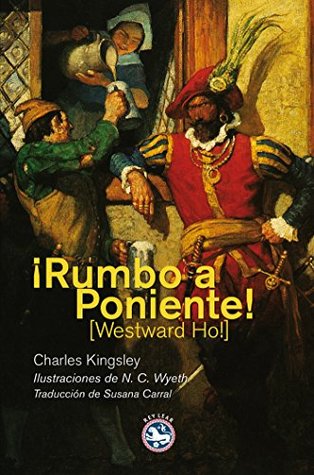
En tiempos de Su Graciosa Majestad Isabel I, Gran Bretaña le disputa a España el dominio del mar. Piratas como Francis Drake obtienen los favores de su Reina atacando a los barcos españoles procedentes de América. Esta es la historia de Sir Amyas Leigh, uno de esos jóvenes caballeros, que se inicia en la piratería emprendiendo viaje hasta el Caribe para enfrentarse a la Armada de Felipe II, medir su valor con las tropas del enemigo y salvaguardar la honra de su amada Rose Salterne, perdida entre los brazos de don Guzmán de Soto. Duelos a espada, persecuciones y abordajes navales, paisajes exóticos y misteriosos tesoros escondidos pueblan esta novela, considerada el gran relato de aventuras navales del siglo xix. La fama de ¡Rumbo a Poniente! (en inglés Westward Ho!) es tal que da nombre a un pueblo de Devon, el único de toda Inglaterra que lleva admiración, y al internado donde Rudyard Kipling estudió y se inspiró para escribir Stalky & Cº. Esta edición íntegra, traducida expresamente por Susana Carral, incorpora todas los dibujos a color que el gran ilustrador norteamericano N. C. Wyeth realizó en 1920 para la mítica edición neoyorquina de Charles Scribner's Sons.






















As a young man, Kingsley was influenced by The Kingdom of Christ (1838) by Frederick Denison Maurice. Originally intended for the legal profession, he changed his mind and chose to pursue a ministry in the church.
In 1850 Kingsley novel Alton Locke was published. The book attempted to expose the social injustice suffered by agricultural labourers and workers in the clothing trade. In Alton Locke Kingsley also describes the Chartist campaign that he was involved with in the 1840s.
Kingsley's life was written by his widow in 1877, entitled Charles Kingsley, his Letters and Memories of his Life, and presents a very touching and beautiful picture of her husband, but perhaps hardly does justice to his humour, his wit, his overflowing vitality and boyish fun.
Charles Kingsley was born in Holne (Devon), the son of a vicar. His brother, Henry Kingsley, also became a novelist. He spent his childhood in Clovelly, Devon and was educated at Magdalene College, Cambridge, before choosing to pursue a ministry in the church. From 1844, he was rector of Eversley in Hampshire, and in 1860, he was appointed Regius Professor of Modern History at the University of Cambridge.
Kingsley's interest in history spilled over into his writings, which include The Heroes (1856), a children's book about Greek mythology, and several historical novels, of which the best known are Hypatia (1853), Hereward the Wake (1865), and Westward Ho! (1855).
In 1872 Kingsley accepted the Presidency of the Birmingham and Midland Institute and became its 19th President.
Kingsley died in 1875 and was buried in St Mary's Churchyard in Eversley.
... Show more