
- Bible
- Read the Bible
- Bible Versions
- Verse of the Day
- Reading Plans
- Verses by Topic
- Books of the Bible
- Bible Images
- Study
- Commentaries
- Concordances
- Dictionaries
- Encyclopedias
- Sermons
- Bible Atlas & Maps
- BP Wiki
- Devotionals
- Today's Devotionals
- Light of the World
- All Devotionals
- Inspirational Quotes
- More
- Picture Quotes
- Videos
- Inspirational
- Bible Study
- What The Bible Says
- Bible Q&As
- Daily Bread
- Bible by Genre
- Bible Stories
- Random Bible Verse
- Community
- Store
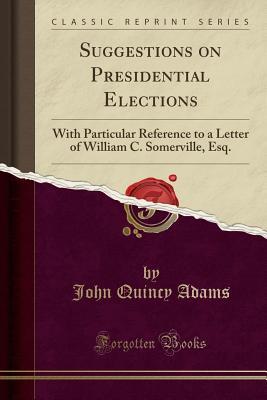
Suggestions on Presidential Elections: With Particular Reference to a Letter of William C. Somerville, Esq. (Classic Reprint)
by John Quincy Adams
Excerpt from Suggestions on Presidential Elections: With Particular Reference to a Letter of William C. Somerville, Esq.
I do not entirel concur in the objections of Mr. Somerville, nor o the Federalist, to a choice of electors by the State Legislatures under certain regulations; but this is a question into which I shall nut enter, for the main feature of the plan which has some months existed in my mind, and which I intended: at a convenient day to make public, is to map of at once the whole system cf electors. Let there be no go-betweens in the case. The people Wish to proceed directly to their object, and to know Who they are voting for - not as a proxy, but as Pres silent. In fact, they do not Wel understand this complicated machinery of electors. I do not believe that there is one Voter out of fifty in new-england, 'who knows or wishes to know any thing about it. The only question at the late election was, what ticket must I put in for Adams, or what for Craw hrd There was no inquiry about the opinions or pretensions of the electors.
About the Publisher
Forgotten Books publishes hundreds of thousands of rare and classic books. Find more at www.forgottenbooks.comwww.forgottenbooks.com
This book is a reproduction of an important historical work. Forgotten Books uses state-of-the-art technology to digitally reconstruct the work, preserving the original format whilst repairing imperfections present in the aged copy. In rare cases, an imperfection in the original, such as a blemish or missing page, may be replicated in our edition. We do, however, repair the vast majority of imperfections successfully; any imperfections that remain are intentionally left to preserve the state of such historical works.
I do not entirel concur in the objections of Mr. Somerville, nor o the Federalist, to a choice of electors by the State Legislatures under certain regulations; but this is a question into which I shall nut enter, for the main feature of the plan which has some months existed in my mind, and which I intended: at a convenient day to make public, is to map of at once the whole system cf electors. Let there be no go-betweens in the case. The people Wish to proceed directly to their object, and to know Who they are voting for - not as a proxy, but as Pres silent. In fact, they do not Wel understand this complicated machinery of electors. I do not believe that there is one Voter out of fifty in new-england, 'who knows or wishes to know any thing about it. The only question at the late election was, what ticket must I put in for Adams, or what for Craw hrd There was no inquiry about the opinions or pretensions of the electors.
About the Publisher
Forgotten Books publishes hundreds of thousands of rare and classic books. Find more at www.forgottenbooks.comwww.forgottenbooks.com
This book is a reproduction of an important historical work. Forgotten Books uses state-of-the-art technology to digitally reconstruct the work, preserving the original format whilst repairing imperfections present in the aged copy. In rare cases, an imperfection in the original, such as a blemish or missing page, may be replicated in our edition. We do, however, repair the vast majority of imperfections successfully; any imperfections that remain are intentionally left to preserve the state of such historical works.
BUY NOW
Paperback, 38 pages
Published September 29th 2018 by Forgotten Books
Subscribe
Get Bible verse every day in your inbox
Read on Mobile



Group of Brands


















© 2025 Bibleportal.com All rights reserved.
John Quincy Adams was the sixth President of the United States from March 4, 1825 to March 4, 1829. He was also an American diplomat and served in both the Senate and House of Representatives. He was a member of the Federalist, Democratic-Republican, National Republican, and later Anti-Masonic and Whig parties.
During his term as president, however, Adams achieved little of consequence in foreign affairs. A reason for this was the opposition he faced in Congress, where his rivals prevented him from succeeding.
Among the few diplomatic achievements of his administration were treaties of reciprocity with a number of nations, including Denmark, Mexico, the Hanseatic League, the Scandinavian countries, Prussia and Austria. However, thanks to the successes of Adams' diplomacy during his previous eight years as Secretary of State, most of the foreign policy issues he would have faced had been resolved by the time he became President.
... Show more