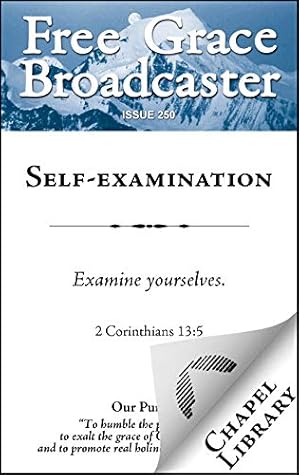
For the good of our immortal souls, we offer the latest FGB, Self-examination. Puritan Thomas Watson helpfully introduces the subject to us. Charles Spurgeon then exhorts us to examine ourselves and gives a useful analysis of the word examine. Wilhemus à Brakel urges us to go even further and examine our faith. With great wisdom and insight, J. C. Ryle warns about his (and our) age of spiritual danger. Arthur Pink shows us that the Scriptures call us to this holy exercise, and Octavius Winslow asks us to dig deep, as we answer his question, “Are you alive or dead?” The Lord’s Supper is always a crucial time to examine our hearts, and Jonathan Edwards helps us to understand who should come to the Table and who should not. Thomas Wilcox gives us some penetrating questions by which we may examine our profession of Christ, and Charles Spurgeon asks yet another pointed question: “Does Christ dwell in you?” Finally, Ryle closes with brief but powerful applications of where to begin and how to proceed with self-examination. Hear those men: they are skilled physicians of the soul.






















He was educated at Emmanuel College, Cambridge, where he was noted for remarkably intense study. In 1646 he commenced a sixteen year pastorate at St. Stephen's, Walbrook. He showed strong Presbyterian views during the civil war, with, however, an attachment to the king, and in 1651 he was imprisoned briefly with some other ministers for his share in Christopher Love's plot to recall Charles II of England.
He was released on 30 June 1652, and was formally reinstated as vicar of St. Stephen's Walbrook. He obtained great fame and popularity as a preacher until the Restoration, when he was ejected for nonconformity. Not withstanding the rigor of the acts against dissenters, Watson continued to exercise his ministry privately as he found opportunity. Upon the Declaration of Indulgence in 1672 he obtained a license to preach at the great hall in Crosby House. After preaching there for several years, his health gave way, and he retired to Barnston, Essex, where he died suddenly while praying in secret. He was buried on 28 July 1686.
Thomas Watson was an English, non-conformist, Puritan preacher and author.
He was educated at Emmanuel College, Cambridge, where he was noted for remarkably intense study. In 1646 he commenced a sixteen year pastorate at St. Stephen's, Walbrook. He showed strong Presbyterian views during the civil war, with, however, an attachment to the king, and in 1651 he was imprisoned briefly with some other ministers for his share in Christopher Love's plot to recall Charles II of England.
He was released on 30 June 1652, and was formally reinstated as vicar of St. Stephen's Walbrook. He obtained great fame and popularity as a preacher until the Restoration, when he was ejected for nonconformity. Not withstanding the rigor of the acts against dissenters, Watson continued to exercise his ministry privately as he found opportunity. Upon the Declaration of Indulgence in 1672 he obtained a license to preach at the great hall in Crosby House. After preaching there for several years, his health gave way, and he retired to Barnston, Essex, where he died suddenly while praying in secret. He was buried on 28 July 1686.
... Show more