
Quote by G.K. Chesterton

“I cannot agree with the gentleman in the magenta coat that Potter’s Pond is only a wretched little hamlet. But it is certainly a very remote and secluded village; so that it seems quite outlandish, like a village of a hundred years ago. The spinsters are really spinsters — damn it, you could almost imagine you saw them spin. The ladies are not just ladies. They are gentlewomen; and their chemist is not a chemist, but an apothecary; pronounced potecary. They do just admit the existence of an ordinary doctor like myself to assist the apothecary. But I am considered rather a juvenile innovation, because I am only fifty-seven years old and have only been in the county for twenty-eight years. The solicitor looks as if he had known it for twenty-eight thousand years. Then there is the old Admiral, who is just like a Dickens illustration; with a house full of cutlasses and cuttle-fish and equipped with a telescope.’ ‘I suppose,’ said Father Brown, ‘there are always a certain number of Admirals washed up on the shore. But I never understood why they get stranded so far inland.’ ‘Certainly no dead-alive place in the depths of the country is complete without one of these little creatures,’ said the doctor. ‘And then, of course, there is the proper sort of clergyman; Tory and High Church in a dusty fashion dating from Archbishop Laud; more of an old woman than any of the old women. He’s a white-haired studious old bird, more easily shocked than the spinsters. Indeed, the gentlewomen, though Puritan in their principles, are sometimes pretty plain in their speech; as the real Puritans were. Once or twice I have known old Miss Carstairs-Carew use expressions as lively as anything in the Bible. The dear old clergyman is assiduous in reading the Bible; but I almost fancy he shuts his eyes when he comes to those words.”
― G.K. Chesterton ,
Be the first to react on this!



Group of Brands


















© 2025 Bibleportal.com All rights reserved.
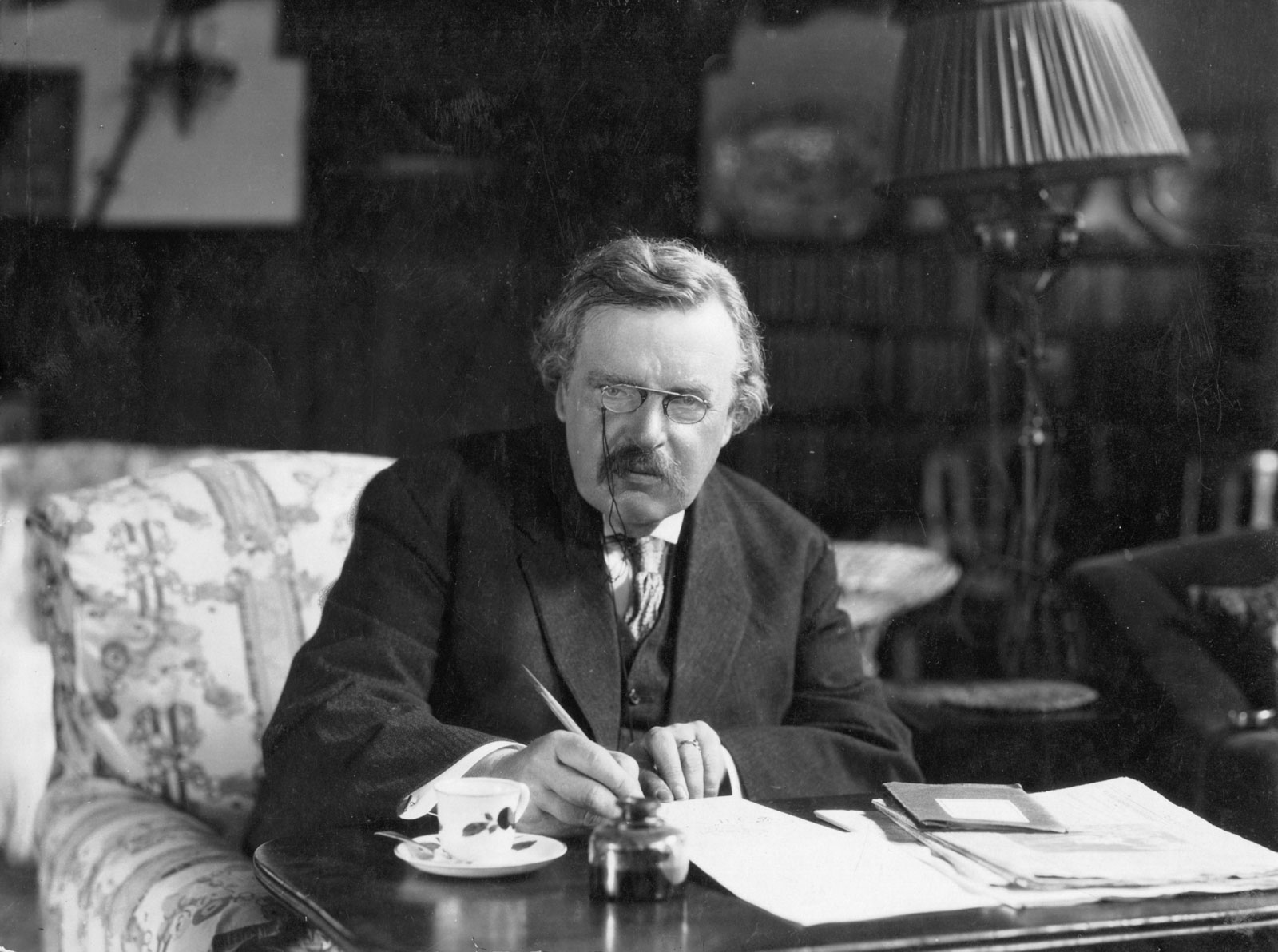
Gilbert Keith Chesterton was one of the most influential English writers of the 20th century. His prolific and diverse output included journalism, philosophy, poetry, biography, Christian apologetics, fantasy and detective fiction.
Chesterton has been called the "prince of paradox". Time magazine, in a review of a biography of Chesterton, observed of his writing style: "Whenever possible Chesterton made his points with popular sayings, proverbs, allegories—first carefully turning them inside out.