
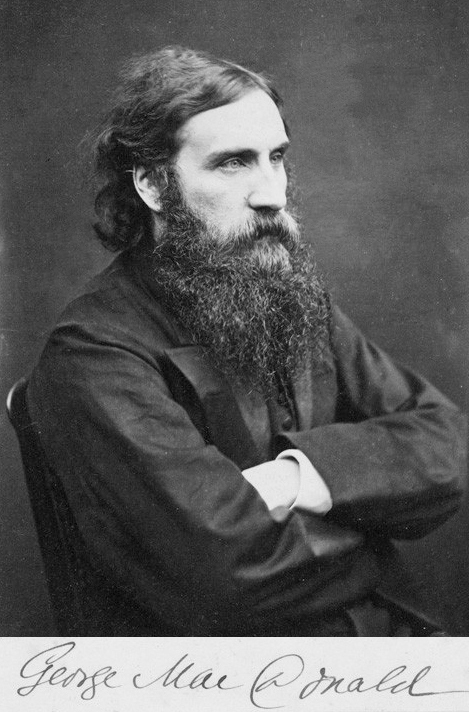
Quote by George MacDonald

“It had been well if he had been left with only a wounded heart, but in that heart lay wounded pride. He hid it carefully, and the keener in consequence grew the sensitiveness, almost feminine, which no stranger could have suspected beneath the manner he wore. Under that bronzed countenance, with its firm-set mouth and powerful jaw--below that clear blue eye, and that upright easy carriage, lay a faithful heart haunted by a sense of wrong: he who is not perfect in forgiveness must be haunted thus; he only is free whose love for the human is so strong that he can pardon the individual sin; he alone can pray the prayer,"Forgive us our trespasses," out of a full heart. Forgiveness is the only cure of wrong. And hand in hand with Sense-of-injury walks ever the weak sister-demon Self-pity, so dear, so sweet to many--both of them the children of Philautos, not of Agape.”
― George MacDonald ,
from Mary Marston
Be the first to react on this!



Group of Brands


















© 2025 Bibleportal.com All rights reserved.
George MacDonald was a Scottish author, poet, and Christian minister.
Known particularly for his poignant fairy tales and fantasy novels, George MacDonald inspired many authors, such as W. H. Auden, J. R. R. Tolkien, C. S. Lewis, E. Nesbit and Madeleine L'Engle. G. K. Chesterton cited The Princess and the Goblin as a book that had "made a difference to my whole existence."
Even Mark Twain, who initially disliked MacDonald, became friends with him, and there is some evidence that Twain was influenced by MacDonald.
MacDonald grew up influenced by his Congregational Church, with an atmosphere of Calvinism. But MacDonald never felt comfortable with some aspects of Calvinist doctrine; indeed, legend has it that when the doctrine of predestination was first explained to him, he burst into tears (although assured that he was one of the elect). Later novels, such as Robert Falconer and Lilith, show a distaste for the idea that God's electing love is limited to some and denied to others.