'C'est un choix décisif devant lequel, déjà, nous sommes placés : ou bien travailler beaucoup pour consommer beaucoup (et c'est l'option de notre société occidentale), ou bien accepter de consommer moins en travaillant peu (et ce fut parfois l'option délibérée de certaines sociétés traditionnelles). Aujourd'hui, nous voudrions tout cumuler, travailler peu et consommer beaucoup.' 'Nous sommes la première société à avoir tout voué au travail. L'histoire des hommes était faite d'une modération, parfois d'une défiance, envers le Travail. Nous sommes devenus les adorateurs du Travail et de nos œuvres.' 'Le travail c'est la liberté. C'est bien la formule idéale de ce lieu commun. Ce qu'il faut qu'il y tienne quand même à la liberté, le bonhomme, pour formuler de si évidentes contre-vérités, pour avaler de si parfaites absurdités, et qu'il y ait de profonds philosophes pour l'expliquer "phénoménologiquement", et qu'il ait d'immenses politiciens pour l'appliquer juridiquement!' S'il n'a jamais consacré d'ouvrage spécifique au travail, Jacques Ellul l'évoque tout au long de son œuvre. Les textes s'y rapportant sont réunis pour la première fois.

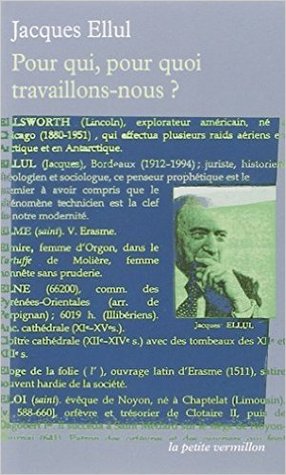





















Jacques Ellul was a French philosopher, law professor, sociologist, lay theologian, and Christian anarchist. He wrote several books about the "technological society" and the intersection between Christianity and politics, such as Anarchy and Christianity (1991)--arguing that anarchism and Christianity are socially following the same goal.
A philosopher who approached technology from a deterministic viewpoint, Ellul, professor at the University of Bordeaux, authored 58 books and more than a thousand articles over his lifetime, the dominant theme of which has been the threat to human freedom and Christian faith created by modern technology. His constant concern has been the emergence of a "technological tyranny" over humanity. As a philosopher and lay theologian, he further explored the religiosity of the technological society.
... Show more