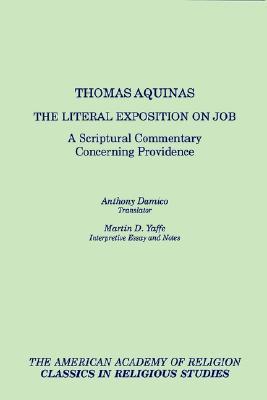
For Thomas Aquinas (1224-74), the Book of Job is the authoritative teaching concerning divine providence. In his Literal Exposition on JobLiteral Exposition on Job, Aquinas offers a line-by-line commentary on the scriptural text. He analyzes the text not only by way of cross-references within the Book of Job and to other parts of Scripture, but also by appeal to the writings of Aristotle, the Church Fathers, and other Christian Aristotelians. Anthony Damico's translation is more literal than literary, preferring to render the Latin words wherever possible by their obvious English derivatives. Martin Yaffe provides an extensive interpretive essay, bibliography, and indexes of citations.






















Thomas Aquinas was an immensely influential philosopher and theologian in the tradition of scholasticism, known as Doctor Angelicus and Doctor Communis.
He was the foremost classical proponent of natural theology, and the father of the Thomistic school of philosophy and theology. His influence on Western thought is considerable, and much of modern philosophy was conceived as a reaction against, or as an agreement with, his ideas, particularly in the areas of ethics, natural law and political theory.
The philosophy of Aquinas has exerted enormous influence on subsequent Christian theology, especially that of the Roman Catholic Church, extending to Western philosophy in general, where he stands as a vehicle and modifier of Aristotelianism, which he fused with the thought of Augustine.
... Show more