
- Biblia
- Leer la Biblia
- Versiones de la Biblia
- Verso del dia
- Planes de lectura
- Versos por tema
- Books of the Bible
- Imágenes De La Biblia
- Estudio
- Comentarios
- Concordancias
- Diccionarios bíblicos
- Enciclopedias bíblicas
- Sermones
- Bible Atlas & Maps
- BP Wiki
- Devocionales
- Devocionales de hoy
- Light of the World
- Todos los devocionales
- Inspirational Quotes
- Más
- Picture Quotes
- Videos
- Inspirador
- Estudio Bíblico
- Lo que dice la Biblia
- Bible Q&As
- Daily Bread
- Bible by Genre
- Bible Stories
- Random Bible Verse
- Comunidad
- Store
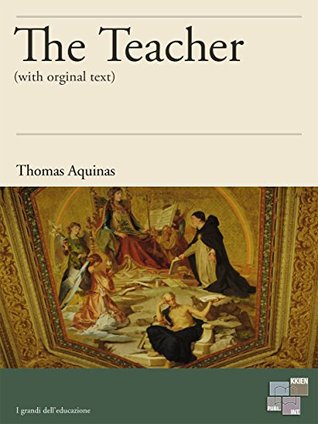
The Teacher (I Grandi dell'Educazione)
by Thomas Aquinas
A good teacher will make the difference between learning by discovery and learning by instruction as narrow as possible. In other words he will assist his students in their learning so that their experience will seem to them a discovery. Some great teachers really have this gift. Their classes are so good that you‘re constantly finding out new things and getting excited about them. The challenge and the enthusiasm of learning are kept alive by the evident love that these men have for their subject. The teachers cannot but communicate to their students who come out of the classroom with a desire to learn more.
The St. Thomas teacher’s role is that of a physician ministering to a man brought down by an infection. In many such cases, if the patient went unattended, his body would mobilize its restorative forces and eventually heal itself. The art of the teacher is like that of this internist, since all the teacher can hope to do is to strengthen the student’s resources and facilitate their exercise. The import of the analogy is clear enough whether it is medically accurate or not. Whenever true learning occurs, its principal cause is the learner himself. In St. Thomas’s terminology the teacher is called a secondary and instrumental cause ―helpful but not indispensable. He cannot transfer his own knowledge to the student but only help him achieve similar learning for himself.
We see that we are far removed from the modern conception of teaching where the teacher exclusively relies on artificial means (workbooks and other devices) and slowly loses sight of his true function: to stimulate the living mind of the student, to guide the development of his intellect. The emphasis on "measuring" education with grades obtained through tests is partly a result of this false philosophy. Knowledge according to St. Thomas is a quality of the living mind and not a quantity of memorized information
It is the teacher’s job to provide the student with a good understanding of the first principles of matters. He will also help the student to sharpen his skill in solving problems by explaining to him the basic process when the pupil has a difficulty, he will give him examples, comparisons, schemas etc….which will be so many "pointers" leading the pupil to grasp this or that particular truth. When you are in front of a wall too high for you to leap, you may need the assistance of someone to point out a ladder which you had not seen. The teacher’s art consists in employing language so skillfully that his student will go beyond the words to the realities they signify.
The St. Thomas teacher’s role is that of a physician ministering to a man brought down by an infection. In many such cases, if the patient went unattended, his body would mobilize its restorative forces and eventually heal itself. The art of the teacher is like that of this internist, since all the teacher can hope to do is to strengthen the student’s resources and facilitate their exercise. The import of the analogy is clear enough whether it is medically accurate or not. Whenever true learning occurs, its principal cause is the learner himself. In St. Thomas’s terminology the teacher is called a secondary and instrumental cause ―helpful but not indispensable. He cannot transfer his own knowledge to the student but only help him achieve similar learning for himself.
We see that we are far removed from the modern conception of teaching where the teacher exclusively relies on artificial means (workbooks and other devices) and slowly loses sight of his true function: to stimulate the living mind of the student, to guide the development of his intellect. The emphasis on "measuring" education with grades obtained through tests is partly a result of this false philosophy. Knowledge according to St. Thomas is a quality of the living mind and not a quantity of memorized information
It is the teacher’s job to provide the student with a good understanding of the first principles of matters. He will also help the student to sharpen his skill in solving problems by explaining to him the basic process when the pupil has a difficulty, he will give him examples, comparisons, schemas etc….which will be so many "pointers" leading the pupil to grasp this or that particular truth. When you are in front of a wall too high for you to leap, you may need the assistance of someone to point out a ladder which you had not seen. The teacher’s art consists in employing language so skillfully that his student will go beyond the words to the realities they signify.
BUY NOW
Kindle Edition, 76 pages
Published August 16th 2013 by KKIEN Publ. Int.
Suscribir
Obtenga el versículo bíblico diario todos los días en su bandeja de entrada
Leer en el móvil



Grupo de marcas


















© 2025 Bibleportal.com Reservados todos los derechos.
Thomas Aquinas was an immensely influential philosopher and theologian in the tradition of scholasticism, known as Doctor Angelicus and Doctor Communis.
He was the foremost classical proponent of natural theology, and the father of the Thomistic school of philosophy and theology. His influence on Western thought is considerable, and much of modern philosophy was conceived as a reaction against, or as an agreement with, his ideas, particularly in the areas of ethics, natural law and political theory.
The philosophy of Aquinas has exerted enormous influence on subsequent Christian theology, especially that of the Roman Catholic Church, extending to Western philosophy in general, where he stands as a vehicle and modifier of Aristotelianism, which he fused with the thought of Augustine.
... Show more