
Quote by Harriet Beecher Stowe

“He saw a chamber, broad and low, designed, in its every rich stain of picture and slumberous hanging, to appeal to the sensuous. And here the scent was thick and motionless. Costly marqueterie; Palissy candlesticks reflected in half-concealed mirrors framed in embossed silver; antique Nankin vases brimming with pot-pourri; in one comer a suit of Milanese armour, fluted, damasquinee, by Felippo Negroli; in another a tripod table of porphyry, spectrally repeating in its polished surface the opal hues of a vessel of old Venetian glass half filled with some topaz-coloured liqueur - such and many more tokens of a luxurious aestheticism wrought in the observer an immediate sense of pleasurable enervation. He noticed, with a swaying thrill of delight, that his feet were on a padded rug of Astrakhan - one of many, disposed eccentrically about the yellow tassellated-marble floor; and he noticed that the sole light in the chamber came from an iridescent globed lamp, fed with some fragrant oil, that hung near an alcove traversed by a veil of dark violet silk. ("The Accursed Cordonnier")”
Be the first to react on this!



Grupo de Marcas


















© 2025 Bibleportal.com Todos os direitos reservados.
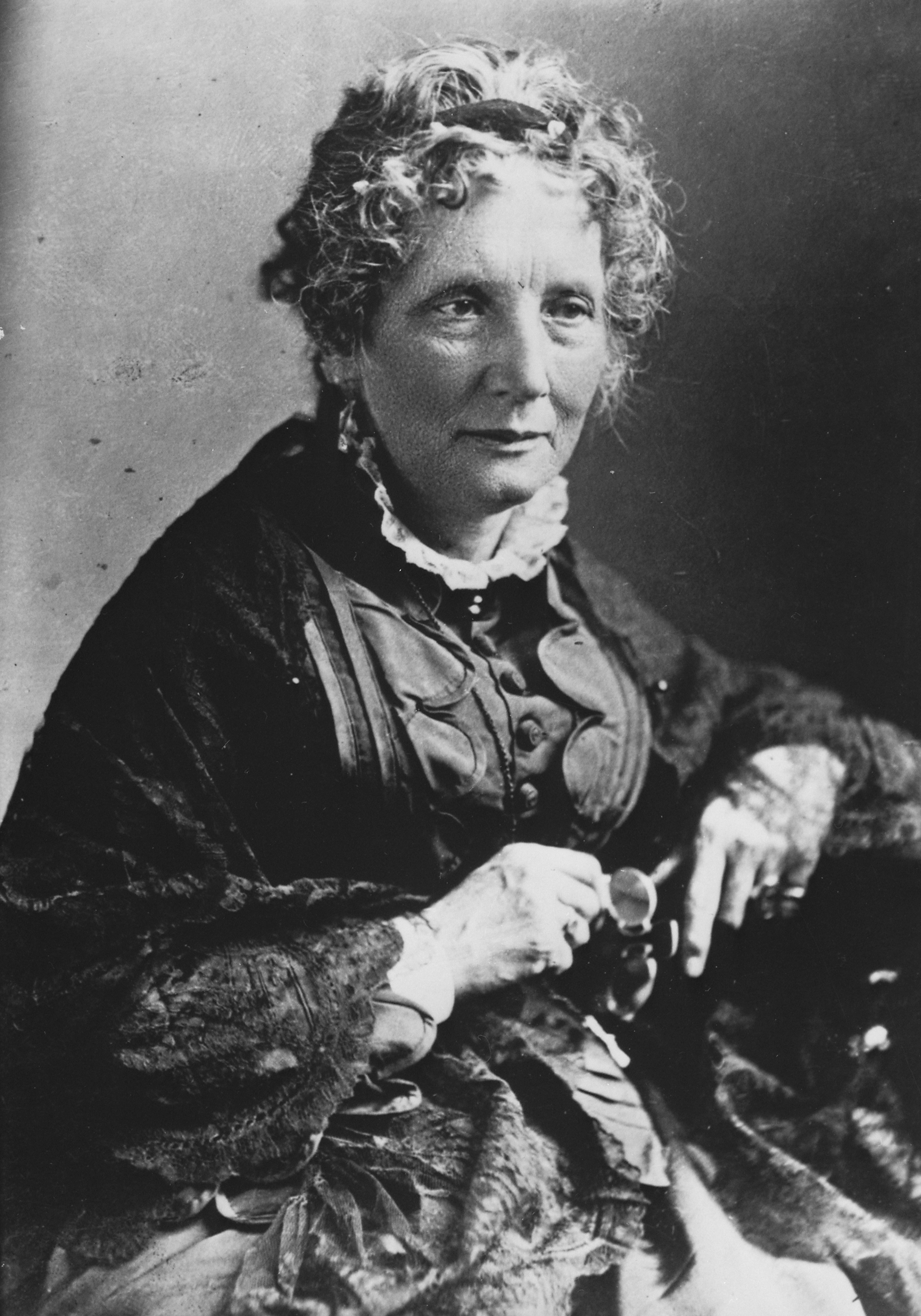
1811-1896
Harriet Beecher Stowe was an American abolitionist and author. Harriet was born in Litchfield, Connecticut, as the daughter of an outspoken religious leader Lyman Beecher. She was the sister of the educator and author, Catherine Beecher, clergymen Henry Ward Beecher and Charles Beecher.
Her father was a preacher who was greatly effected by the pro-slavery riots that took place in Cincinnati in 1834.
Stowe's novel Uncle Tom's Cabin (1852) depicted life for African-Americans under slavery; it reached millions as a novel and play, and became influential in the U.S. and Britain and made the political issues of the 1850s regarding slavery tangible to millions, energizing anti-slavery forces in the American North, while provoking widespread anger in the South. Upon meeting Stowe, Abraham Lincoln allegedly remarked, "So this is the little old lady who started this new great war!"