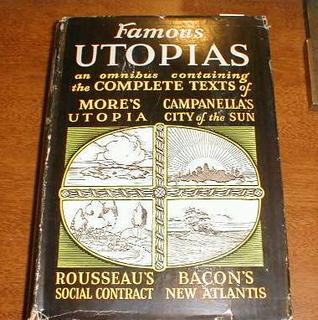
Complete Texts:
Rousseau's Social Contract
More's Utopia
Bacon's New Atlantis
Campanella's City of the Sun
Copyright, 1901, by M. Walter Dunne, Publisher
This volume collects English translations of the four utopian works listed above, introduced by Charles M. Andrews, Ph.D.
NB: it appears upon a cursory glance that this century-old volume has been recently reprinted with an alternate title & is listed elsewhere on GoodReads as Famous New Deals of History: Rousseau's Social Contract; Sir Thomas More's, Utopia; Bacon's, New Atlantis; Campanella's, City Of The Sun.






















Sir Francis Bacon, 1st Viscount St Alban KC, son of Nicholas Bacon by his second wife Anne (Cooke) Bacon, was an English philosopher, statesman, scientist, lawyer, jurist, and author. He served both as Attorney General and Lord Chancellor of England. Although his political career ended in disgrace, he remained extremely influential through his works, especially as philosophical advocate and practitioner of the scientific revolution. Bacon was knighted in 1603, created Baron Verulam in 1618, and Viscount St Alban in 1621.
There are some scholars who believe that Bacon's vision for a Utopian New World in North America was laid out in his novel The New Atlantis, which depicts a mythical island, Bensalem, in the Pacific Ocean west of Peru. He envisioned a land where there would be greater rights for women, the abolishing of slavery, elimination of debtors' prisons, separation of church and state, and freedom of religious and political expression. Francis Bacon played a leading role in creating the British colonies, especially in Virginia, the Carolinas, and Newfoundland.
Thomas Jefferson considered Francis Bacon to be one of the three greatest men who ever lived, "Bacon, Locke and Newton" were "the three greatest men that have ever lived, without any exception." Francis Bacon's influence can also be seen on a variety of religious and spiritual authors, and on groups that have utilized his writings in their own belief systems.
... Show more